|
|||||||||||||||||
|
|||||||||||||||||


|
Projet Karyne - A Visit to Kingston! |
||||||
|
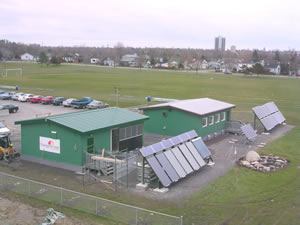
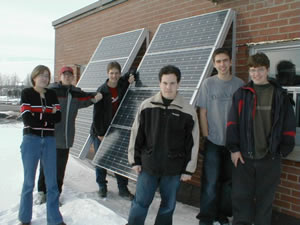
We have returned from our trip to Kingston which took place on March 23! ! The trip was extremely informative and interesting. Here is a short summary of what we learned there. FRONTENAC SECONDARY SCHOOL Our first stop was "Frontenac Secondary School (F.S.S.)" . We asked many questions to their solar panel project lead, and science teacher, Lucille Davies. This school installed two solar panels which are P.V. Modules (Photovoltaic). (To see a photo of their solar panels scroll to the bottom of this page. Their school applied to the government for funding. At the time there was a "Climate Change Action Fund" which was their primary source of funding. That program doesn't exist anymore because of government cutbacks. Their project cost approximately $6000, which included also many volunteer hours. The company "Plum Hollow" provided the solar panels at cost, which means they didn't make any profit. At F.S.S. their are no grade 7 or 8 students. The school starts at grade 9. In their Grade 9 science class, the students have to build something that is powered by solar panels. Each year the Solar Club of the school organizes a solar boat race for the elementary feeder schools. Grade 7/8 students build small boats out of recycled material and race them in a local swimming pool. Another way of getting the students involved was via poster contests across the elementary schools with prizes. An interesting project this year was that the school found out about a company who dedicated laptops to a poor country in Africa. The problem was that the school had no electricity to be able to use the laptops. F.S.S. was part of a project that raised money to put solar panels on the school roof which are working now, to provide power to the laptops! This project was done in conjunction with Queens' University. When asked "what would you do differently if you could do the whole project all over again?" the response was that they would have publicized even more to tell the community about the project. It needs to be visible and people need to be told repeately that it exists to get the community interested. As for a phase 2, F.S.S. would like next to invest in a wind turbine. A special thanks to Lucille for organizing this trip for us and for taking the time to share her experiences. ENERGY HOUSE Our 2nd stop was Energy House, which is part of St. Lawrence College. Steve Lapp is in charge there and runs an program for environmental technicians. They have two portables at the back of the college which proudly display many different types of PV panels, solar water heaters and a solar wall.
- solar panels in our area should have an angle equivalent to the latitude of the location. We should have them at a 40-50 degree angle. But countries at the equator would have them at 0 degrees. - we don't have to clean the solar panels they don't need any maintenance - buying a tracker isn't really worth it because the tracker itself uses energy to turn. it's only worthwhile in countries where there is much more sun than we have. - it probably isn't a good idea to store the solar energy in batteries for the school because you lose energy when you store it. It's better to use it right away or if there is excess to send it back to the hydro grid for money. The Ontario government standing offer now pays you 42c per kW if you put energy back to the grid; they charge 10c per kW for energy you take from the grid. - installing a solar water heater at our school might not be the best use of solar energy. We can't feed solar-heated water into our boilers at the school which are used to heat the school because the boilers work at an extremely high temperature. The solar hot water would have to be chanelled into another heater then fed into the boilers so it defeats the purpose of having solar hot water. We could, however, use solar hot water for our basic hot water tanks. This is a great use of solar energy for houses. For schools, though, since we are shut down all summer long when the most solar energy is available, it is actually bad to have a solar hot water heater sitting in the sun if no water is circulating through it. The water gets too hot and the solar heater can be damaged. For our purposes we may be better off looking at PV Panels or a solar wall. - Greenhouse gas emissions are not the same as smog. Greenhouse gas is directly related to the amount of fossil fuel being consumed, regardless of anti-pollution systems. Smog emissions are related to the pollution your car produces after it has burnt fuel, which can be reduced with catalytic converters. - a good product to use which is free from the government is called retscreen.net. It can be used to study the energy produced by your system and get statistics. - other ways the school can become more environment-friendly are: a) by buying a 'vending mizer' which turns off vending machines when there is no need to have them turned on. b) saving on paper... alot of paper is used in schools. try using the internet more; or overhead projectors if possible
|
 He generously
spent over three hours showing us all about solar technology and
answering our questions. Here are some of the things we learned
from Steve:
He generously
spent over three hours showing us all about solar technology and
answering our questions. Here are some of the things we learned
from Steve: